Spider Dance Notes & Stories Excerpt
beginning in Summer 2025 each seasonal apothecary box has come with a pdf with accompanying info, art, stories on the boxes theme. What follows is an excerpt of Estate 2025’s Spider Dance doc.
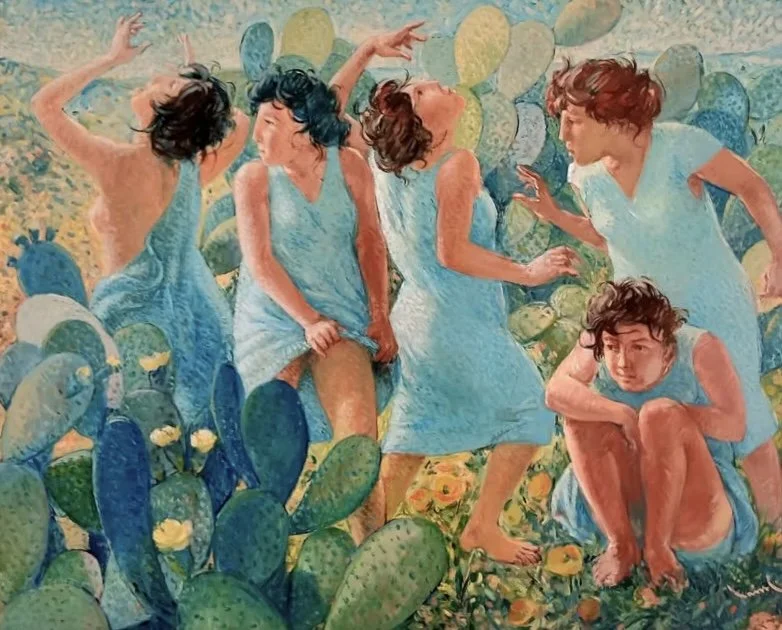
Luigi Caiuli, Le Baccanti, circa 1978-1998.
Spider Dance Notes & Stories
Estate 2025
“Knowledge is only a rumor until it lives in the muscle.”
Proverb of the Asaro Tribe of Indonesia and Papua New Guinea
Lycosa Tarantula is the species originally known as the tarantula. Today, amongst English speakers the term tarantula actually refers to spiders in the Theraphosidae family, while the original Lycosa Tarantula is more specifically known as the tarantula wolf spider and belongs to the wolf spider family.
This Spider is native to Southern Europe, particularly in Puglia around the city of Taranto, from which it got its name.
"Everything in the universe has rhythm. Everything dances."
—Maya Angelou
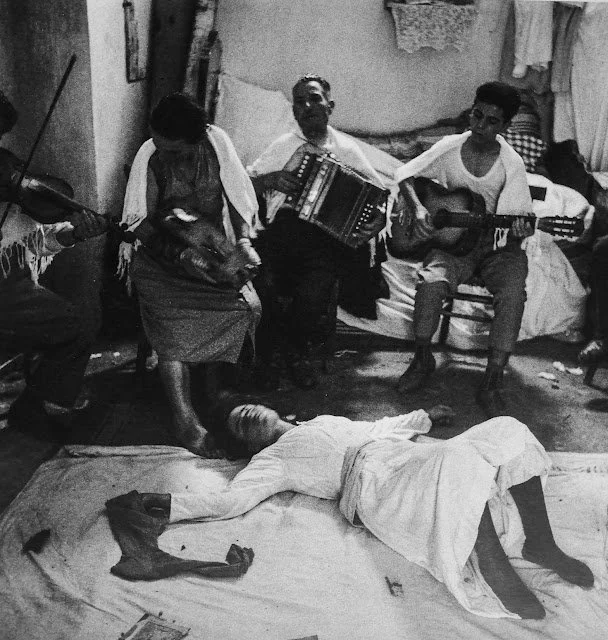
One of 464 photos took by Franco Pinna while conducting field work in Salento, Puglia in the summer of 1959 with Ernesto de Martino for what would become his seminal work on tarantismo, “La Terra del Rimorso”
This summer’s collection of plant medicine is themed around dance and how healing it is, and specifically centers around one family of healing dances–the Pizziche of Puglia. This is of course just one of many healing dances on Earth, no superior or more important than any other, just one I know intimately and feel is a good microcosm to illustrate just how medicinal dancing can be, and how necessary it is during the hardest of times. While I typically include a story about the seasonal medicine boxes themes on paper in the box, I felt it more appropriate to keep this portion digital this time. At first I just didn't want to be limited by what I could afford to print and then I realized it also suits what I’d like to share better. What follows are notes, quotes, films, photos, songs, and stories about Pizziche and the larger web we weave through movement–in hopes of inspiring you to sing and dance as often as you can.
“In the narrowest sense, The Land of Remorse is Apulia, inasmuch as this is the elective area of tarantism—a historical-religious phenomenon which developed in the Middle Ages and continued to the eighteenth century and beyond, to the present relics still usefully observable in the Salentine Peninsula. Tarantism is a “minor,” predominantly peasant religious formation, although at one time it involved the upper classes, too; it is characterized by the symbolism of the taranta which bites and poisons, as well as the symbolism of music, dance, and colors which deliver its victim from the poisoned bite. In a wider sense, though, the Land of Remorse—the land of a wretched past which returns and regurgitates and oppresses with its regurgitation—is Southern Italy, or more precisely the lands of what was the old Kingdom of Naples. This was a kingdom which, hemmed in between the Papal States and the sea, suggested to one of its kings the image of a land shielded from history and nearly outside of this world, “between holy water and salt water,” between the patrimony of St. Peter and the sea. The Land of Remorse aspires to be a molecular contribution to a religious and cultural history of our South, in the prospect of a new dimension of the Southern Question. This means that the molecular phenomenon from which the historical discourse takes its cue—tarantism—is not considered in its local isolation (in which case it would be vain to attempt to insert it into a history). Rather, tarantism is first of all examined here in its genesis and persistence in a fully Christian epoch; second, in the way in which Catholicism, natural magic, Enlightenment reason and positivism all reacted to it; and finally, the way in which we ourselves can react to it, within a historicism and humanism which are increasingly sensitive to everything concerning “remorse,” the return of the wretched past, the past that was not chosen. For in a third and still broader sense, The Land of Remorse is our whole planet, or at least that part of it which has entered the shadow-cone of its wretched past.”
—Ernesto de Martino, The Land of Remorse: A Study of Southern Italian Tarantism
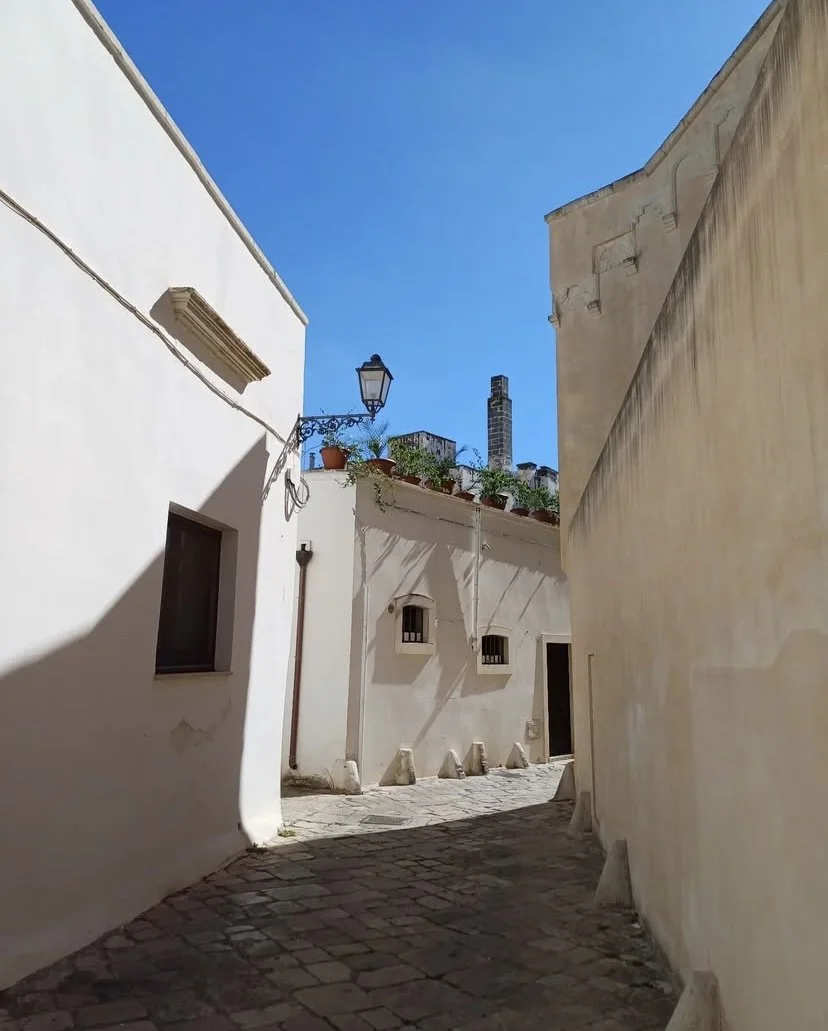
Woman dances Pizzica in the Street
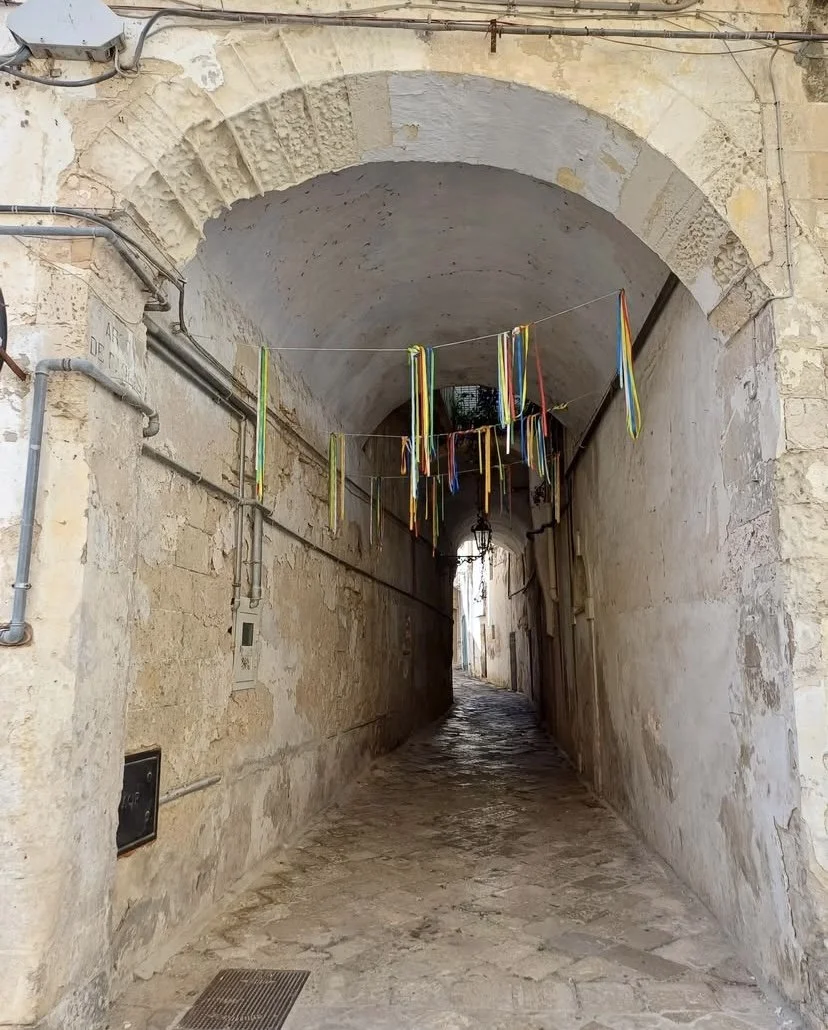
Zagareddhe decorating Galantina for the festival of Saint Peter and Paul.
One of my great grandmother’s, Zuzu, is from Bari, so I spent many summers growing up in Puglia. Song and dance are so ingrained here, they’re no longer second nature. The first time I remember seeing Pizzica, I was 6. I doubt it was the first time I experienced Pizzica, it's just the furthest back I can excavate memory of it. I remember the energy of it–the tambourines, frenetic beat, the rhythm, the wild nature of it all. I remember thinking about Spiders.
The Tarantula Wolf Spider has a silken sac that contains over 100 eggs which the mother carries attached to her spinnerets. When they hatch, the baby spiders climb on the Mothers abdomen and ride around with her for a while until they are ready to survive on their own.
All across Southern Italy, hundreds of dance lineages exist independent of one another that all fall under the umbrella of Tarantelle, despite how different and unique they all are. The Pizziche dances differ from the many other regional dances in many ways and takes on many different forms—there are essentially different versions of it depending on the situation. Going back as far as we can, it was likely originally an erotic dance, then an ecstatic dance performed by people devoted to Dionysus. Fast forward to the Catholic church taking over and things getting outlawed left and right and we see it change shape and emerge as a dance done by people feeling deeply repressed by the society being imposed on them. This endures to this day. But it is also a celebratory dance–used in courtship, and between intimate partners, as well as danced with friends casually on the land and in the streets. It’s also unique in how it has endured and remained itself over time. People in Puglia still dance Pizziche all the ways it's always been danced. Italian immigrants also dance true Pizziche in other places around the world. Puglia has also gotten a lot of attention for this dance and it is now celebrated as a large festival, La Notte della Taranta, each summer. Local dancers gain notoriety from their skill and have developed artistically sound choreography as a way to share and teach others how to dance Pizzica. And alongside all this, the wilder versions remain.
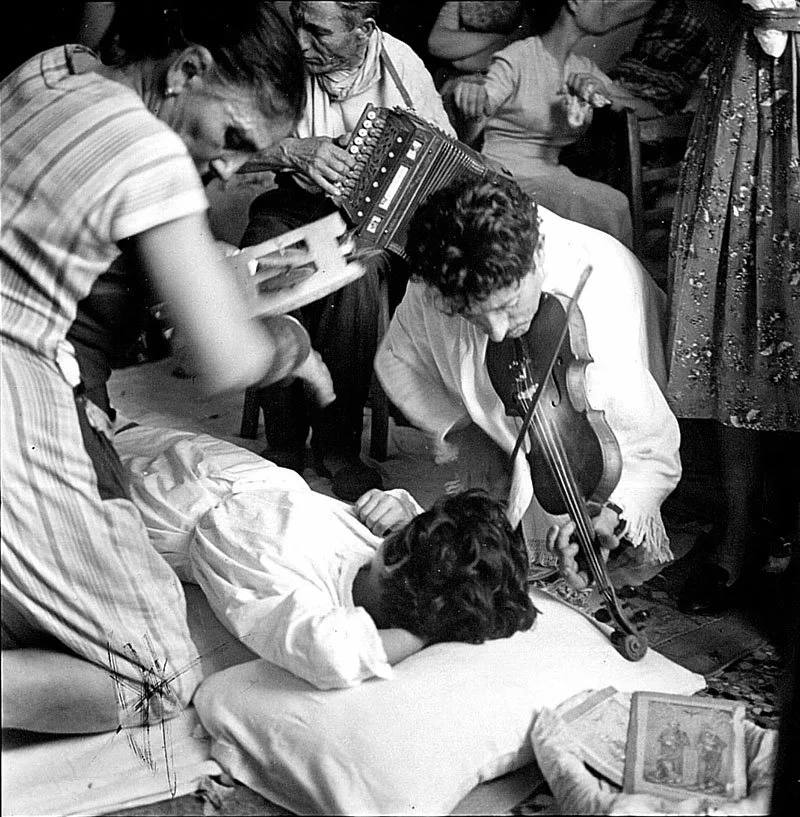
Salvatora Marzo and Luigi Stifani, Home Therapy of Tarantism, 1959. ph Diego Carpitella
Tarantismo is a cultural phenomenon in Southern Italy–a malaise whereby the afflicted, called tarantata(e), become overcome by melancholy, depression, or mania and can only be consoled and cured by the music and dance of the pizzica tarantata. Documentation of this goes back to the 11th century. In the summer of 1959, Ernesto de Martino went to Salento with a team to study this ritual, which up until this point was described as solely being caused by the bite of the tarantula. This is another aspect I have always found so interesting–ascribing the cause as being bitten by a spider was, as I understand it, a symbolic explanation used by those from Salento and understood as symbolic by those familiar. However to outsiders, those unfamiliar with the local cosmologies, worldviews, and vernacular interpreted this as literal and for such a long time this became the sole explanation without much question or consideration. I guess it made enough sense to people without much context–the afflicted were mostly, but not always women, who often worked outside in the fields in intense heat–so it wasn't a stretch for those unfamiliar with the spiders or the landscape to believe they occasionally get bit by a spider and exorcise the poison out in this unique way.
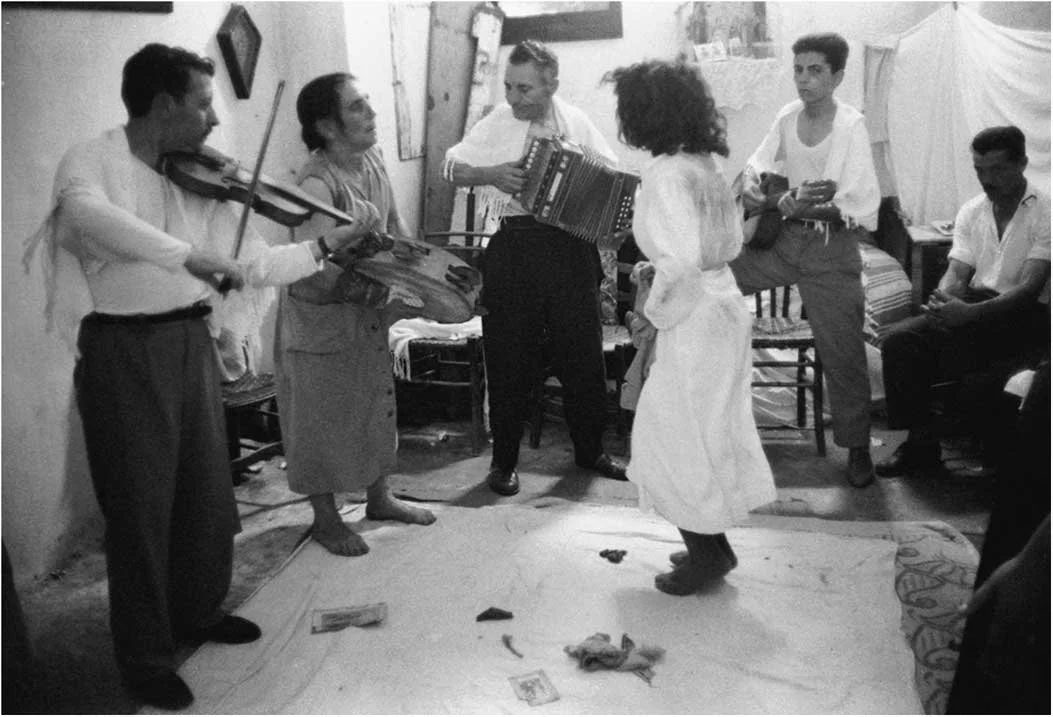
But the more you know—the tarantate who weren’t women were often gay men, or men whose gender expression did not fit the rigid societal one imposed on them. All of the tarantate lived in very poor social conditions–often they were not allowed to marry who they really loved and were instead forced to marry whoever their father chose for them. They were often sexually abused by the landowners they worked for, or their own husbands, and often endured domestic abuse as well. Other times they had lost a close family member. Many of their first “bites” happened at puberty. Suffering in silence is the thread, and the explosion of their desires and grief expressing themselves freely though their bodies was the antidote. They let out their pain when they danced. They operated outside the margins during this ritual, no longer bound by everything society imposed on them–and they could do so because it was socially agreed upon in this unspoken way that they would not be judged as sinners but as people who were ill and in need of support. For centuries this took place on the land, inside homes, mainly in the summer. When Catholicism came into the picture and realized it could not stop this, it subsumed it, as much as it could anyway–which ultimately meant putting some parameters on it. Now it takes place during June mainly, typically in the days leading up to the 19th, Saint Peter and Paul’s feast days. This ritual lasted for a few days often, with ordinary village people playing the instruments, family looking after the afflicted, and would often start in their homes and then make their way to the Church of Saint Paul in Galantina where the tarantate would continue their dancing in front of the town and inside the church–continuing the wild movements to the fast rhythm, jumping on the altar and all over the church, climbing onto the statue of the saint and asking to be healed.
After the Spiders part ways with their Mother, the young Spiders separate and dig burrows to live in. Females live in the burrows their whole lives which can be up to 4 years long, only leaving at night to hunt. Whereas the males, usually living for 2 years, often leave their burrows to search for mates.
The link above is to a documentary made by Gianfranco Mingozzi, in collaboration with de Martino’s research and book release, which gives a glimpse of the tarantate and the ritual. It is often said that tarantismo died out in the 1980s. Despite de Martino’s research being groundbreaking and validating–in that it told the truth but also did not assign the subjects as being in need of judgment or help; in fact they concluded that the music and dance really did serve their therapeutic purpose–ultimately its publication led to doctors going to Salento to try and treat these people with medication and electric shock therapy which resulted in any public display of this ritual “dying out”. It of course continued behind closed doors, and on the Earth, out of view.
About one third of the Tarantula Wolf Spider’s sexual encounters end in the females cannibalizing the male instead.
The link above is to a documentary made by Gianfranco Mingozzi, in collaboration with de Martino’s research and book release, which gives a glimpse of the tarantate and the ritual. It is often said that tarantismo died out in the 1980s. Despite de Martino’s research being groundbreaking and validating–in that it told the truth but also did not assign the subjects as being in need of judgment or help; in fact they concluded that the music and dance really did serve their therapeutic purpose–ultimately its publication led to doctors going to Salento to try and treat these people with medication and electric shock therapy which resulted in any public display of this ritual “dying out”. It of course continued behind closed doors, and on the Earth, out of view.
About one third of the Tarantula Wolf Spider’s sexual encounters end in the females cannibalizing the male instead.
Ci e taranta lassala ballare
Ci e malencunia cacciala fore
If it’s taranta let it dance
If it’s melancholy chase it out
–Pizzica Tarantata
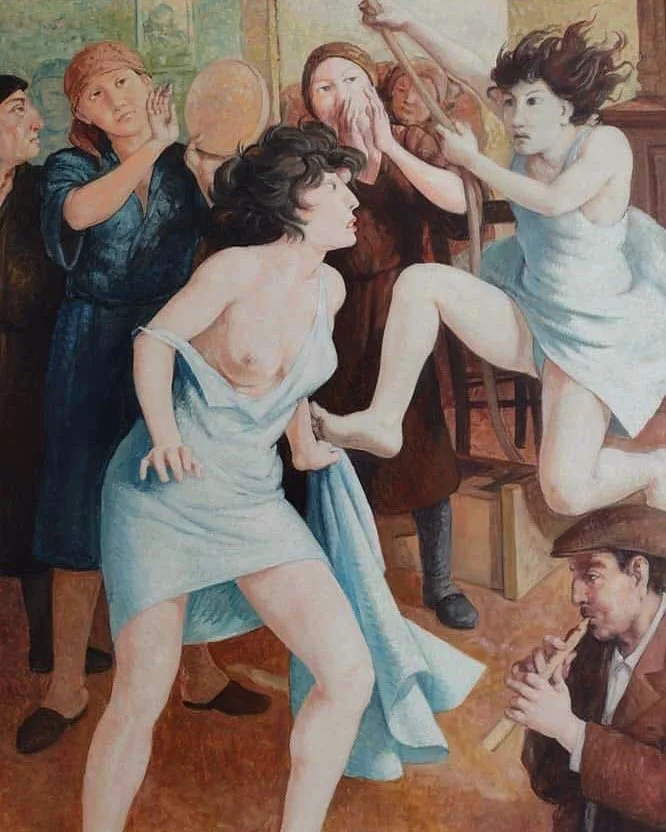
another one of Caiuli’s Tarantismo paintings.